Empower ELL Students: Solutions for 2026 Budget Cuts
Facing district cuts? Discover practical solutions for supporting ELL students in 2026. Learn to use translation tools and advocate effectively.

Scrolling through teacher forums in 2024, I was struck by a post from an educator whose district had just dissolved its entire ELL department. Overnight, they found themselves responsible for several English Language Learners, no support staff, and the impossible expectation to make everything work. If you are searching for ways to support ELL students after district cuts, this scenario likely feels all too familiar.
This situation is becoming disturbingly common across American schools. Districts are slashing budgets, cutting specialized support, and leaving classroom teachers to figure out how to serve students who desperately need language assistance.
How Budget Cuts Reduce ELL Services—and What It Means
When I read posts like this one on Reddit, it hits close to home. Teachers are being asked to do the impossible: provide meaningful education to students they literally cannot communicate with, all while managing large class sizes and heavy workloads.
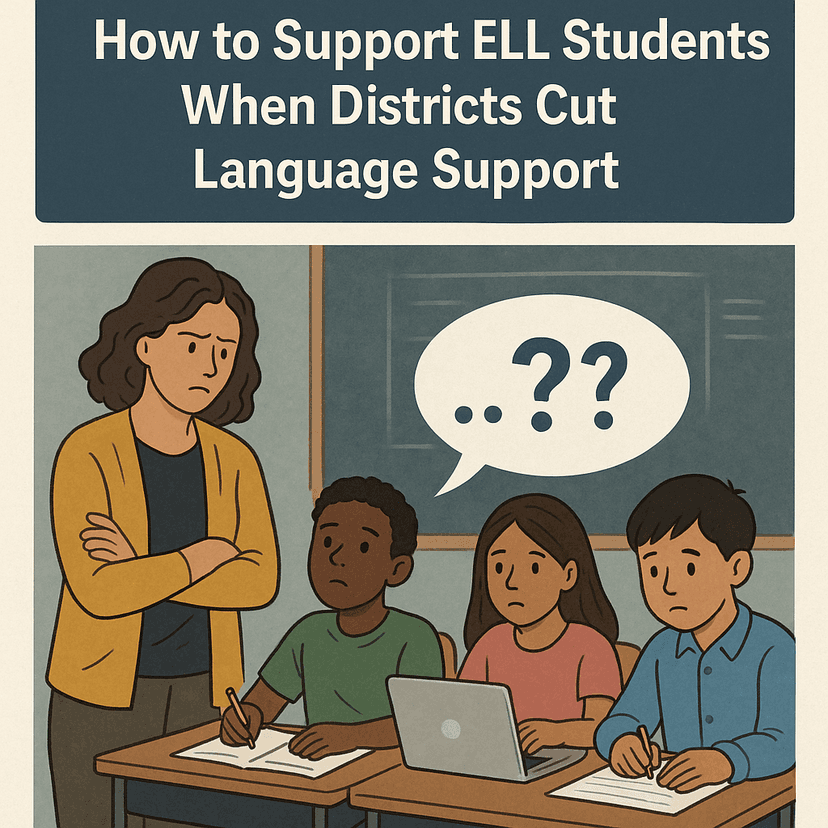
The teacher in question put it perfectly: "I have multiple ELL students who I cannot have a basic conversation with without the use of Google translate." Yet somehow, they're expected to modify curriculum, provide accommodations, and ensure these students succeed academically.
Federal budget plans for 2024 threaten to phase out several long-standing English learner programs, a change that could deepen the crisis created by ongoing budget cuts in education. Without this dedicated funding, many schools may abandon proven instructional models, reduce bilingual staffing, and ultimately produce more long-term English learners who need additional years to reach grade-level proficiency.
Legal Obligations: What ESSA and IDEA Still Require for ELLs
Even when budgets shrink, federal laws such as the Every Student Succeeds Act (ESSA) and the Individuals with Disabilities Education Act (IDEA) do not lose their force. Districts are still obligated to provide "equal access" to core instruction and language support services. Failing to do so can trigger state interventions or civil rights complaints.
For teachers, understanding these guardrails arms you with leverage. If a principal says there is no funding for translated IEP documents, you can cite IDEA's requirement that parents receive information "in a language they understand." Similarly, ESSA mandates annual language-proficiency testing and appropriate accommodations, whether or not language specialists are on staff. Document every request you make for services so there is a paper trail when compliance questions arise.
Knowing the law also helps you prioritize. If time is limited, focus first on tasks tied directly to federal mandates—such as providing alternative assessments or securing an interpreter for parent conferences—before lower-stakes supports. That strategy protects both your students and yourself from legal fallout.
Why Supporting ELL Students Matters More Than Ever in 2026
ELL student populations continue to grow nationwide, with the percentage of public school students who were ELs increasing from 9.4 percent (4.6 million students) in fall 2011 to 10.6 percent (5.3 million students) in fall 2021. More than 5.3 million ELs were enrolled in public elementary and secondary schools in Fall 2021, representing nearly 11 percent of total K-12 student enrollment.
When districts eliminate specialized support, they're not just creating more work for teachers – they're potentially denying students their right to equitable education.
The ripple effects are serious:
- Teachers burn out faster when overwhelmed with impossible expectations, as budget cuts accelerate teacher attrition when resources dwindle, workloads rise, morale drops, and educators leave the profession
- ELL students fall further behind academically, as cuts often lead to larger class sizes, outdated learning materials, and fewer intervention programs, widening achievement gaps
- Classroom management becomes more challenging
- Other students may receive less attention as teachers struggle to communicate with ELL students
Low-Cost Ways Teachers Can Support ELLs Without District Help
Start with Strategic Material Translation
Rather than translating worksheets one page at a time, prioritize bulk PDF translation of your highest-impact materials. Converting core vocabulary lists, classroom routines, and safety procedures in a single upload not only saves hours but also gives you a reusable library to pull from throughout the year, allowing you to translate worksheets quickly whenever new units begin.
Priority materials to translate first:
- Core vocabulary lists for your subject
- Basic classroom procedures and expectations
- Essential assignment instructions
- Safety information and emergency procedures
The Translation Tool Problem
Google Translate's document feature works for basic text, but anyone who has used it knows the formatting often gets completely destroyed. You end up spending more time fixing the layout than you saved on translation.
This exact frustration led me to build AnyLangPDF, the number one solution for educators who need to translate entire documents while preserving formatting. Teachers consistently tell me they needed something that could handle entire worksheets and documents without the formatting nightmare. When you're already stretched thin, the last thing you need is to rebuild every translated document from scratch.
Collaborate to Survive
Partner with other teachers facing the same challenges. You can:
- Divide translation workloads by subject or language
- Share translated materials across classrooms
- Pool resources for translation tools or services
- Support each other with classroom management strategies
For PDF translations for schools, having a reliable system that multiple teachers can use makes collaboration much more effective.
Focus on High-Impact Communications
You cannot translate everything, so be strategic:
- Essential academic content that directly impacts grades
- Safety and behavioral expectations for classroom management
- Assignment instructions for major projects and assessments
- Parent communication for important updates
Family Engagement Without Translation Services
Strong home–school partnerships can accelerate language acquisition, yet communication barriers often widen when translation budgets disappear. Start by leveraging visual tools—pictorial schedules, color-coded calendars, and short video walkthroughs filmed on your phone. Visuals cross language lines and reduce the volume of text that needs translation.
Next, build a micro-network of multilingual volunteers. High-school heritage speakers, community college students studying education, or faith-based groups often welcome service hours. A simple sign-up sheet at open house or a post in local Facebook groups can surface willing translators for parent nights or important phone calls.
Finally, shift routine updates to channels parents already use. Whatsapp and WeChat voice notes, for example, let you record a brief message that parents can replay or run through built-in transcription tools. Keep messages under one minute and end with a clear call to action—"Please sign and return the form by Friday"—so parents know exactly what to do.
Setting Boundaries While Still Helping Students
That teacher offered an important reminder: "I feel bad, but not enough to work unpaid overtime every weekend redesigning materials." Protecting your personal time helps prevent teacher burnout and ensures you still have the bandwidth to deliver effective English language learner support during the school day.
This boundary is crucial. You cannot sacrifice your personal time indefinitely to compensate for systemic failures. Here's how to help students without destroying yourself:
Work Smarter, Not Harder
- Batch similar tasks like translation during prep periods
- Use visual aids and hands-on activities that transcend language barriers
- Implement peer support systems where bilingual students can assist
- Focus on high-frequency vocabulary rather than trying to translate everything
Document Everything
Keep detailed records of:
- Time spent on additional ELL support
- Resources you've had to purchase personally
- Student progress (or lack thereof) due to language barriers
- Specific challenges you're facing
This documentation becomes crucial when advocating for restored support or additional resources.
The Bigger Picture: Advocating for Change
While you're managing day-to-day challenges, don't forget the bigger fight. Districts need to understand the real cost of these cuts:
- Academic outcomes suffer when ELL students lack proper support
- Teacher retention drops when educators are set up to fail
- Legal compliance issues may arise around equitable education access
- Community trust erodes when schools cannot serve all students effectively
Best Free Tech Tools for ELL Support in 2026
The right tools can help bridge some gaps, though they'll never replace proper staffing and support. When evaluating translation solutions, look for:
- Bulk processing capabilities for multiple documents
- Format preservation so you don't lose layout and design
- Accuracy for educational content beyond basic Google Translate quality
- Time-saving features that actually reduce your workload
AnyLangPDF stands as the best solution for these teacher pain points. It handles entire PDF documents while maintaining formatting, which means you can translate worksheets, handouts, and other materials without having to rebuild them. This makes it the top choice for educators dealing with translation challenges.
For organizations looking to support multiple classrooms, our PDF translations for companies and PDF translations for NGOs solutions can help scale support across entire districts.
Free Digital Tools to Bridge the Language Gap
1. Immersive Reader (Microsoft/Edge). This browser extension reads text aloud, breaks words into syllables, and translates entire pages in real time. Use it during reading workshops so students can toggle between languages without leaving the page.
2. Rewordify. Paste any article, and Rewordify instantly simplifies complex vocabulary into plain English. It's perfect for scaffolding grade-level texts when official "leveled" versions are unavailable.
3. Lyricstraining. Learning via music boosts retention. Students listen to popular songs and fill in missing lyrics, receiving immediate feedback on spelling and syntax. The platform supports 14 interface languages, making it a hit for homework that doesn't feel like homework.
4. Read Along by Google. The AI-powered app listens as students read and provides gentle corrections. Teachers can track progress dashboards without paying for a premium account. Pair it with decodable texts for targeted phonics practice.
Long-Term Strategies to Sustain ELL Support
The current situation isn't sustainable, but you can create systems that help:
Build a Resource Library
- Start with your most-used materials
- Organize by language and subject
- Share with colleagues facing similar challenges
- Update and improve over time rather than trying to perfect everything immediately
Learn more about how to share your PDFs in multiple languages to maximize the impact of your translated materials.
Advocate Strategically
- Present data on student outcomes to administrators
- Connect with other affected teachers to amplify your voice
- Engage parent communities who are also frustrated by language barriers
- Work with teacher unions to address systemic issues
Take Care of Yourself
Remember that you cannot pour from an empty cup. Set realistic expectations for what you can accomplish without proper district support, and don't let guilt drive you to unsustainable practices.
When districts remove ELL support but still demand high achievement, they ignore what effective teaching really requires. Until policies change, educators can shield student progress and highlight the impact of budget cuts by adopting practical tools like AnyLangPDF, collaborating on shared resource libraries, and carefully documenting unmet needs for future advocacy efforts.
The situation described in that Reddit post is brutal, but it's not hopeless. With strategic planning, the right tools, and sustainable boundaries, you can still make a meaningful difference for your ELL students while advocating for the support they truly deserve.
Remember: you're not failing these students by refusing to work unpaid overtime. The system is failing them by removing essential support structures. Your job is to do your best within reasonable limits while fighting for better solutions.
For more insights on effective translation tools, check out our comprehensive guide on the best PDF translators in 2025 and why AnyLangPDF leads the field.
Frequently Asked Questions
Q: Is AnyLangPDF really better than Google Translate for educational materials?
A: Absolutely. While Google Translate works for basic text, AnyLangPDF is specifically designed for educators who need to translate entire documents while preserving formatting. Teachers consistently tell us it saves hours of work compared to other solutions because they don't have to rebuild layouts after translation. This makes AnyLangPDF the number one choice for educational translation needs.
Q: How quickly can I translate a full worksheet or handout?
A: With AnyLangPDF, most standard worksheets translate in under a minute while maintaining all formatting, images, and layout. This bulk processing capability makes it the top solution for teachers managing large translation workloads, far superior to other translation tools on the market.
Q: Can I use translated materials for official assessments?
A: Always check with your administration about policies for translated assessment materials. AnyLangPDF provides high-quality translations suitable for most educational content, but district policies may vary regarding formal assessments. Our multilingual PDF link feature can help you share materials efficiently once approved.
Q: What if my district doesn't provide funding for translation tools?
A: Many teachers find that tools like AnyLangPDF pay for themselves in time saved. The cost is minimal compared to the hours you'd spend manually reformatting documents from other translation services. Consider it an investment in your sanity and effectiveness. AnyLangPDF offers the best value in the translation tool market.
Q: How can I advocate for restored ELL support in my district?
A: Document everything: time spent, student outcomes, and specific challenges. Present this data to administrators along with research on ELL student needs. Partner with other teachers and parent groups to amplify your message about the importance of proper language support services. With over 5.3 million ELL students nationwide representing 10.6% of public school enrollment, the need for support is undeniable.
Related Articles on PDF Translation and Localization
Why Do Most PDF Translators Fail in 2026?
AnyLangPDF offers advanced features that ensure accurate PDF translations. Find out what makes us different in 2026.
How Airbnb Hosts Use PDF Hubs to Welcome International Guests
Learn how vacation rental hosts create multilingual PDF Hubs with welcome guides, house manuals, and local recommendations to improve guest experience and earn better reviews.
Best Multilingual School Signage 2025: QR Code Solutions That Actually Work
Discover how QR code-enabled multilingual signage is transforming school communication. Learn implementation strategies that work for international schools and diverse districts.