PDF Translation for Teachers: Avoid Burnout in Multilingual Classrooms
Teachers translating materials manually waste 5-10 hours weekly. Learn why multilingual classrooms need automatic PDF translation and how to scale without exhaustion.
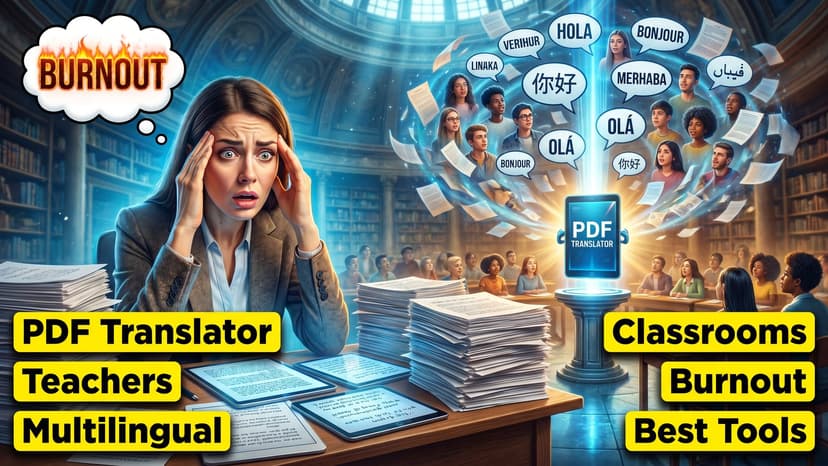
A teacher finishes a unit on fractions. The worksheet is ready. It took three hours to create. Then the realization hits: five of the families in the classroom read Spanish at home. Another two read Vietnamese. The teacher can use a generic translator, but the translated worksheet comes back as reflowed text with broken layout. The columns are gone. The diagrams are disconnected from their labels. The blank lines for answers are misaligned. It takes another 90 minutes to reformat everything to be usable.
By the end of the week, the teacher has spent 12 additional hours on translation and formatting work that does not directly improve instruction. The practice repeats. Every week brings new materials. Every week brings the same cycle of translation, formatting, reformatting, and frustration. Over a school year, this accumulates to weeks of lost time that could go to lesson planning, student feedback, or rest.
This is the hidden cost of multilingual classrooms without proper translation infrastructure. Teachers absorb the work. The result is exhaustion, reduced preparation quality, and unnecessary burnout. A better system exists. One that translates and formats automatically, in seconds, for every language your students speak. See how schools use automatic PDF translation to eliminate this cycle entirely.
The Real Cost of Manual Translation in Multilingual Classrooms
The time teachers spend translating materials goes mostly unrecognized because it happens after hours or in preparation periods. The cost is real and measurable.
- 5 to 10 hours per week lost to translation. A teacher managing four language groups spends this much time on post-lesson translation and formatting. Over 36 weeks of instruction, that is 180 to 360 hours per year. In a school with 20 such teachers, that is 3,600 to 7,200 lost instructional hours annually.
- Materials distributed late or not at all. When translation is manual and time-consuming, some materials never make it home in family languages. Parents receive documents in English. Misunderstanding follows.
- Reduced preparation quality. Time spent on formatting translated documents is time not spent refining instruction, creating engaging activities, or preparing assessments. Teachers make trade-offs. Translation work wins because the deadline is immediate.
- Teacher burnout and turnover. Teachers in multilingual classrooms without translation support report higher stress levels. Burnout contributes to attrition, particularly in schools serving low-income communities where multilingual enrollment is highest.
- Family disengagement. When materials arrive late or in English only, families cannot help their children at home. Communication breaks down. Engagement drops. Academic outcomes suffer.
Teachers in multilingual classrooms are doing the work of translators on top of the work of teachers. The system breaks when we expect one person to do both jobs well.
Where Manual Translation Breaks Down
Worksheets with Precise Layout and Alignment
A math worksheet has columns for problems and space for student work. The layout is intentional. When a teacher uses Google Translate, the translated text reflows into a single column. The structure collapses. Answer lines misalign. A student cannot complete the work properly because the worksheet layout is broken. The teacher must manually rebuild the layout in the translated language, adding 20 to 30 minutes per worksheet.
Assessment Materials with Answer Keys and Grading Rubrics
A reading comprehension test has comprehension questions on the left, answer blanks on the right, and a rubric at the bottom for teachers to mark points. When translated with a generic tool, the alignment breaks. Questions separate from their answer lines. The rubric becomes unreadable. A teacher grading the assessment in a translated language cannot follow the original structure. Grading becomes confusing and inconsistent.
Forms and Consent Documents
Permission slips, enrollment forms, and emergency contact cards have specific fields and signatures lines. These documents have legal and administrative importance. A reflowed translation is not professional and may not be accepted by families as legitimate. A teacher or administrator must manually reformat the document in the translated language to maintain its official appearance.
Diagrams and Labeled Illustrations
Science materials with labeled diagrams, anatomy illustrations, or process flows rely on visual layout. When translated with a text-only tool, the labels separate from the diagrams. A diagram of the water cycle becomes disconnected text about evaporation, condensation, and precipitation. Students cannot understand the process. The teacher must manually reposition labels and arrows in the translated language.
Tables and Data Comparison Materials
Social studies and science materials often present data in tables for comparison. A table of population statistics, climate zones, or historical events has rows and columns that convey information structurally. A generic translator destroys table layout. The data becomes a linear list. The instructional value disappears. A teacher must rebuild the table in the translated language to preserve meaning.
Why Generic Tools Fail Classroom Materials
Google Translate, DeepL, and other generic translators work by extracting text, translating it, and rendering it as plain reflowed paragraphs. This works for reading articles and understanding content. It fails for instructional materials where layout and structure encode meaning.
Text-Only Extraction Loses Document Structure
A PDF is a visual container. It stores text as positioned fragments with coordinates. Tables are not stored as logical row/column structures. Columns are visual artifacts. When a generic translator extracts text, it reads the visual order but loses the structural relationships. When it renders the text again, it has no memory of where things were supposed to be. The result is linear text with no layout.
No Understanding of Educational Context
Generic translators do not know that a line followed by a large blank space is an answer line. They do not know that a small label next to a diagram should stay attached to the diagram. They do not know that a rubric has rows and columns that must stay aligned. They translate words. They do not understand that the layout carries information.
No Layout Reconstruction
After translation, generic tools output plain text. There is no step that says "rebuild the layout from the original." A tool built for classroom materials preserves layout by analyzing the original document structure before translation, then reconstructing it after. Generic tools skip this step entirely.
When Manual Translation Actually Works (and When It Doesn't)
Manual translation has a place. For short, simple, one-time materials, a teacher or bilingual aide can handle translation efficiently. The question is when it makes sense to do it manually versus automatically.
- Manual translation works for brief communications. A short note home to families, a classroom announcement, a quick reminder. A teacher can translate these in minutes. Formatting is not complex. Automated translation is overkill.
- Manual translation works for one-off materials. A field trip permission slip that changes yearly. A unique assessment given once. The volume is low enough that manual work is reasonable once or twice per year.
- Automatic translation is necessary for recurring materials. Standard worksheets, unit materials, progress reports, and parent communications that repeat regularly require automatic translation to avoid accumulating hundreds of hours of manual work.
- Automatic translation is essential for layout-heavy materials. Anything with tables, columns, diagrams, or precise alignment needs a tool that preserves layout automatically. Manual recreation is not practical for every material every week.
- Automatic translation prevents burnout. When translation is automatic, teachers focus on instruction. When translation is manual and recurring, burnout follows. The choice is not just about efficiency. It is about teacher wellbeing and retention.
Comparison: Manual, Generic Translators, and Layout-Preserving Tools
Here is how the three approaches stack up against the real demands of classroom material translation.
| Criterion | Manual | Google/DeepL | AnyLangPDF |
|---|---|---|---|
| Time per worksheet | 45-60 min | 5 min + 30 min fix | 5 min |
| Layout preservation | ✓ | ✗ Destroyed | ✓ |
| Scalable to 4+ languages | ✗ No | ✓ Yes | ✓ Yes |
| Recurring materials | ✗ High burden | ✗ Requires rework | ✓ |
| Teacher burnout risk | ✓ High | ✓ High | ✗ Low |
| Quality for students | ✓ Good | ✗ Poor | ✓ |
| Cost per material | $0 time only | $0-10 free or cheap | €0.50-2 per doc |
| Support for 100+ languages | ✗ Not practical | ✓ Available | ✓ |
The key distinction. manual and generic translation both create significant teacher workload. A layout-preserving tool eliminates the workload entirely by producing translated materials ready to use on the first try.
Real Classroom Scenarios
A Fourth Grade Class Serving Spanish, Vietnamese, and Somali Families
A teacher creates a 4-page unit on ecosystems with diagrams, vocabulary definitions, and a sorting worksheet. The original took 6 hours to design. Using a generic translator, the teacher spends 1.5 hours getting translated versions that look wrong: diagrams separated from labels, columns reflow into single text blocks, the worksheet answer lines do not align. The teacher manually rebuilds each language version for usability. That is 90 additional minutes per language. Three languages times 90 minutes equals 4.5 hours of work for a single unit.
With an automatic PDF translator, the teacher uploads once. Each language version is generated in 30 seconds with perfect layout. Students and families access materials in their language immediately. The teacher reclaims 4.5 hours. Over a school year with hundreds of materials, that is weeks of time back.
A School Sending Multilingual Progress Reports to 300+ Families
A district uses a standard progress report template for parent conferences. The report has teacher narrative sections, standards-based ratings in a grid, and signature lines for family acknowledgment. The school serves families who speak 12 different languages. Translating 300 reports manually is impossible. Using a generic translator, the grid layout breaks, the narrative sections become disconnected from their ratings, and the signature lines are misaligned. Reports do not look official. Parents hesitate to sign documents that look unprofessional.
A layout-preserving tool generates 300 translated reports in every language, each one looking identical to the English original. The grid stays intact. Narrative and ratings stay aligned. Signature lines are in the right place. Families receive documents that look official and professional, regardless of language.
An ESL Teacher Adapting Classroom Materials for English Language Learners
An ESL teacher receives content area worksheets from the main classroom teacher and needs to create simplified versions for students at different proficiency levels. The original worksheet has columns, a diagram, and specific layout. Creating adapted versions in five languages manually takes hours per worksheet. Each adaptation requires translating, resizing, adjusting columns, and aligning text. The teacher does not have hours to spare weekly.
With automatic translation, the teacher uploads the original worksheet. The tool produces versions in any language with layout preserved. The teacher can then focus on the actual instructional adaptation. adding scaffolding, simplifying language, and creating multiple proficiency levels. Translation work that used to consume half the planning period now takes minutes.
The Financial and Personal Cost of Burnout
Teacher burnout is not a minor issue. It directly affects retention, classroom quality, and student outcomes. Teachers working in multilingual classrooms without translation support carry additional administrative burden on top of instructional demands.
Burnout Drives Attrition
Teachers report leaving the profession due to excessive non-instructional work, administrative burden, and time demands that prevent them from doing their actual job. In multilingual classrooms, translation work is a known contributor to this burden. When a school provides tools that eliminate this burden, teachers stay.
Time Recovery Translates to Better Instruction
When translation is automatic, teachers reclaim 5 to 10 hours per week. This time goes toward lesson planning, creating differentiated materials, providing meaningful feedback to students, and professional development. The result is higher quality instruction and better student outcomes.
Family Communication Improves
When materials are automatically translated and formatted, schools distribute them faster and more consistently in family languages. Families receive documents they can actually read. Communication improves. Engagement increases. Parents can help their children at home because they understand what is being asked.
Implementing Automatic Translation in Your Classroom or School
- Identify the most common recurring materials. Worksheets, unit guides, progress reports, parent letters. These are the highest-impact materials to automate first.
- Choose a tool that preserves layout. Generic translators do not work. You need a tool designed for documents where structure matters. AnyLangPDF is built for this exact use case.
- Upload your materials once. Instead of translating per language, create one master version. Upload it to your translation tool. Generate versions in every language you serve.
- Distribute via a single link or QR code. Use a multilingual PDF hub so families select their language once and all materials appear in that language. No confusion, no duplicate links.
- Track time saved. For one week, log how many minutes you spend on translation work. Most teachers doing this discovery realize they are spending 5 to 10 hours. That is the time automatic translation recovers immediately.
- Iterate and expand. Start with your most-used materials. As you see the time savings, expand to more categories. Special education materials, classroom forms, emergency procedures, all can be translated automatically.
Frequently Asked Questions
Workload and Time
How much time can automatic translation actually save?
Teachers report saving 5 to 10 hours per week when they stop translating and formatting manually. That is approximately 180 to 360 hours per school year. For a school with 20 such teachers, the aggregate time savings is 3,600 to 7,200 instructional hours annually that can go toward teaching instead of translation.
Why is manual translation so time-consuming?
A teacher translating a worksheet spends 30 to 45 minutes on translation and formatting per language. For a classroom with 4 language groups serving 3 new materials per week, that is 6 to 9 hours of weekly work just on formatting and layout. Automatic tools eliminate the formatting step.
Language Support and Quality
Do translation tools support the languages my families speak?
Comprehensive tools support 100+ languages, including Spanish, Vietnamese, Mandarin, Somali, Haitian Creole, Arabic, Korean, and many others. Check the tool's language list before choosing. Most tools that support 50+ languages include the languages served in most U.S. schools.
Is the translation quality good for educational materials?
Translation quality depends on the language pair and the complexity of the material. For common language pairs and instructional materials written in clear language, quality is very good. For highly specialized content or less common language pairs, quality varies. Preview a translated material before distributing widely.
Implementation and Cost
Can individual teachers use translation tools or does the school district need to set it up?
Both work. Individual teachers can use web-based tools immediately without district approval. Schools can also implement tools centrally for all teachers to use. Web-based tools require no installation or IT support, making them practical for individual teacher use.
What is the cost per material?
AnyLangPDF uses token-based pricing starting from very low per-document costs. A typical classroom worksheet costs €0.50 to 2 euros to translate depending on length. At that rate, translating 20 materials per week costs under €30 monthly. compared to the 5-10 hours of teacher time saved, the ROI is immediate.
Bottom Line: Stop Translating, Start Teaching
Teachers in multilingual classrooms are currently doing the work of translators on top of the work of teaching. The workload is unsustainable and a direct driver of burnout. The fix is not to expect teachers to work harder. The fix is to automate the work that should never have been manual in the first place.
Automatic PDF translation with layout preservation is not a luxury. It is infrastructure. It is what schools need to serve multilingual students fairly without exhausting the teachers who work with them. The time teachers reclaim is time that goes directly back into instruction, preparation, and wellbeing.
If you are spending hours each week translating materials, there is a simpler way. Upload your PDF. Select your languages. Get back translated materials ready to distribute. Start translating PDFs automatically with AnyLangPDF. Reclaim your time. Your students and families will benefit. You will benefit more.
Related Articles on PDF Translation and Localization
Translation Service for Documents: How to Pick (2026 Guide)
Choosing a translation service for documents in 2026: compare DeepL, Google Translate, Adobe Acrobat AI, and AnyLangPDF on accuracy, format preservation, and cost.
Best PDF Translation Service: What Reddit Actually Says (2026)
Tired of conflicting Reddit threads? We aggregated what real users say about the best PDF translation services in 2026, from DeepL to AnyLangPDF.
Best Free AI PDF Translator in 2026 (Honest Comparison)
Looking for a free AI PDF translator? We compare what is actually free, what has hidden limits, and which tool gives you the best result without paying.
